
What an AI pet health app can actually do
An AI pet health app can judge urgency and remember your pet's history. It cannot diagnose. Where the AVMA draws that line, and how to read an answer.

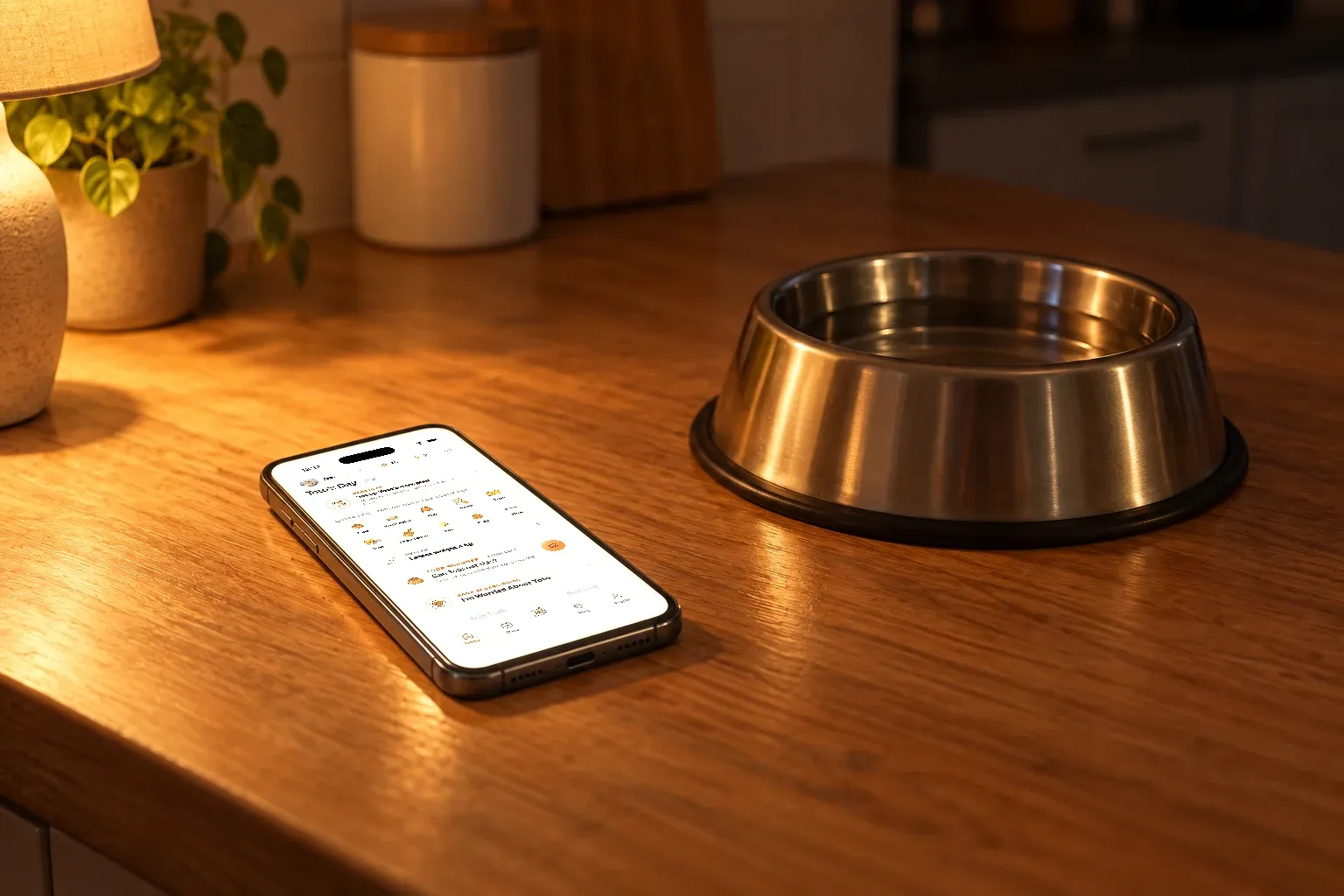
The dog has not touched dinner, it is nearly eleven, and the clinic opens at eight. You search the app store and get back a wall of results with names like PetVet AI, most of them promising an answer in seconds. In September 2026, seven of the first eight Google results for “ai pet health app” were product pages selling one. Almost nobody publishes what these things can and cannot do, so here is that page.
An AI pet health app is good at judging how urgent a situation looks, at holding your pet’s history so an answer is grounded in your animal, and at turning what you saw tonight into something a veterinarian can read quickly tomorrow. It cannot diagnose, and in most places it is not permitted to try. Knowing which side of that line you are standing on is most of the skill.
What is an AI pet health app?
The label covers products that do unrelated things. A symptom checker takes your description and returns an urgency judgement. A record keeper with a language model on top lets you ask questions about your own logs. A collar measures activity and resting respiration, then interprets the numbers for you. They share a category in the store and very little else.
The American Veterinary Medical Association has vocabulary that separates them, and it is worth borrowing because it names jobs that look identical from outside. Its telehealth policy treats telehealth as the umbrella term and lists teleadvice, teletriage and telemedicine underneath it as different activities. Teletriage decides how soon an animal should be seen. Telemedicine evaluates, diagnoses, prescribes and treats. Software can assist with the first. The second belongs to a licensed veterinarian who has met your animal.
What is it genuinely good at?
The useful work is unglamorous, and most of it is about memory rather than intelligence. You will not remember that the limp started on the Tuesday of the long weekend, or that the weight has been creeping up since spring, or which of the two anti-inflammatories she reacted to last year. Software remembers all of that perfectly and can hand it back in the order a clinician wants it.
Sorting urgency is the other half, and it helps that the question is narrower than it feels. At eleven at night people rarely need to know what is wrong. They need to know whether it can wait until morning, which is a much easier thing to answer well.
| The question you have | Who can answer it |
|---|---|
| How urgent is this, right now? | An app can help you sort it. So can a clinic’s after-hours triage line. |
| What is wrong with my pet? | A veterinarian, after examining the animal. |
| Should I change or stop this medication? | The veterinarian who prescribed it. |
| What did we give her, and at what time? | Your own record, if somebody kept one. |
| Is this food safe for this animal? | A reference check first, then your vet for anything uncertain. |
| How has her weight moved over two years? | Your own record. Nothing else has the data. |
The right-hand column splits the same way every time. The rows an app owns are the ones about your history and your next move. The rows it does not own are the ones that need hands on an animal.
Why will it not diagnose?
Because a diagnosis is a claim about a body nobody has examined, and the profession has drawn that line deliberately.
The AVMA policy states that the association “opposes telehealth offered directly to the public when the intent is to diagnose, prescribe for and/or treat a patient in the absence of a veterinarian-client-patient relationship”. It goes on to say that a veterinarian should establish that relationship by conducting an in-person physical examination or visiting the premises where the patient is kept, with an exception carved out for a life-threatening emergency or severe suffering until the relationship can be formed.
That wording is worth reading twice, because it stops sounding like caution and starts sounding like a description of what is physically missing. A model cannot palpate an abdomen, take a temperature, or notice that the gums have gone pale.
Who checks these apps before they ship?
Mostly nobody, and that is the part the category does not advertise.
AVMA News reported in October 2023 that companies developing medical devices for animals are not required to undergo premarket screening, unlike companies developing devices for people, and that the American College of Veterinary Radiology has raised concern about the lack of oversight for software used to read radiographs. The same article records the consequence: because there is no requirement to publish how a product was trained or validated, these algorithms are often described as operating in a black box.
This applies to us as much as to anyone. Dana ships an AI feature, and no regulator reviewed it before release. What a vendor can honestly do is say that out loud, then build so that being right about a diagnosis is never what the product depends on.
How do you read an AI answer without being fooled by it?
Five habits, whichever app you ended up with.
- Read the output as a sorting decision. What you act on is “go now”, “book soon” or “watch and see”, plus what to watch for. Any label that sounds like a condition is a guess with a clinical vocabulary.
- Check what it was given. An answer that never had the species, the age, the current weight or the medication list was written about a generic animal that happens to share a symptom. If correcting the weight changes nothing, the weight was decoration.
- Watch how it behaves when it has no answer. A tool that says “I cannot tell from this, and here is who can” earns more trust than one that always produces a confident paragraph. Confidence is cheap to generate.
- Escalate on anything that names an emergency. Bloat, poisoning, seizure, breathing trouble, a suspected block. Stop reading and call. The reading can happen in the car.
- Keep what you typed. The description you wrote at 11 PM is better evidence than the summary you will give from memory at 9 AM, and your vet would rather have the first one. Our vet visit checklist covers what else to bring.
What it still cannot do
It cannot examine your animal, and no amount of training data changes that. It cannot run bloods, feel a lump, or tell that something is wrong in the way a person who lives with that dog can tell.
It also cannot know what nobody wrote down. An app that answers from your pet’s history is only as good as that history, so a household that logs nothing gets generic answers dressed in a personal tone. That is a recordkeeping problem, and the fix for it is keeping the record; the guide to pet health records covers what belongs in it. A cleverer app will not supply the missing year.
Where Dana fits
Dana AI sorts a worry into emergency now, call the vet today, or monitor at home, and it never diagnoses. A check weighs your pet’s species and age with what you describe. A question you ask is answered from the pet’s own health record: the latest weight, current medications, vaccines and the last week of logs, which is where the difference between an answer about your dog and an answer about dogs comes from. Every check is saved to the pet’s timeline, so the appointment that follows starts from what you saw at the time, and every answer carries the same line: not a substitute for emergency veterinary care. The page on Dana’s AI pet health app covers how it works, and the Food Scanner answers the separate question of whether a particular food suits a particular animal, weighing species, age and the latest weight. If you’re choosing between apps, our comparison of pet health tracker apps sets the options side by side.
Questions people ask
Can an AI app diagnose my pet?
No. The AVMA's telehealth policy opposes telehealth offered directly to the public when the intent is to diagnose, prescribe for or treat a patient without a veterinarian-client-patient relationship, and it says that relationship should begin with an in-person examination or a visit to where the animal is kept. An app can help you judge urgency. Diagnosis needs somebody who has examined the animal.
Are AI pet health apps regulated?
Far less than their human-medicine equivalents. AVMA News reported in October 2023 that companies developing medical devices for animals are not required to undergo premarket screening, unlike those developing devices for people, and that the American College of Veterinary Radiology has raised concern about the lack of oversight for software that reads radiographs.
What is the difference between triage and diagnosis?
Triage decides how soon an animal needs to be seen. Diagnosis decides what is wrong with it. The first is a sorting job that a trained person, a clinic phone line, or a piece of software can help with. The second requires an examination and a licence.
How do I know whether the answer was about my pet?
Check what the app was given. If it never had the species, the age, the current weight or the medications, it answered about a generic animal that happens to share a symptom. An answer that changes when you correct the weight was using the weight.
Is it worth using one at 2 AM?
For the question people actually have at 2 AM, which is whether this can wait until morning, yes. Keep the emergency number to hand anyway, and treat anything the app flags as urgent as a reason to call rather than a reason to read further.