
The shared pet care app, without the group chat
Dana is a shared pet care app for everyone who helps with the animal: a partner, a roommate, a sitter, an ex with custody weekends. Each person gets the right level of access, and every feed, walk and pill lands in one timeline, signed with who did it and when.
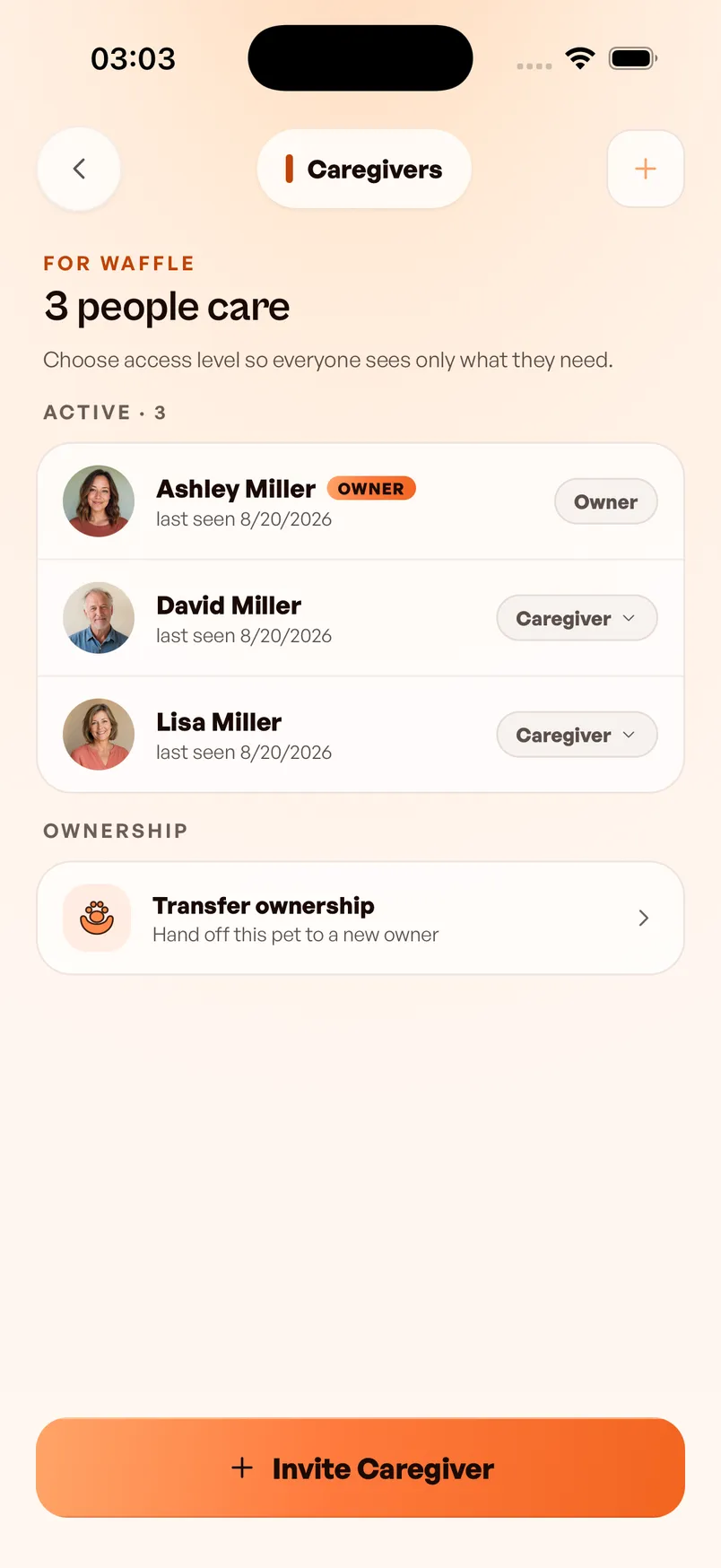
Who is it for?
Any household where more than one person looks after the same animal. Couples who both feed the dog and want to stop asking each other. Roommates who split the walks. A family where the adults log what the kids helped with, a sitter covering one week, and two homes sharing one dog. The roles are the same in every case; only who holds which one changes.
Roles, not chores
Owners run the pet, caregivers do and log daily care, limited caregivers see only the tasks meant for them. Any caregiver can cover any task, because the record, not a person, says what is done. The guide to sharing pet care goes deeper.
A care plan that builds itself
Answer a few questions about your pet and Dana proposes a starter care plan. Tasks repeat, sit in the morning, afternoon or evening (or anytime), and can go to one named person or to anyone in the household. Editing the plan only changes future days, so the record of what already happened stays as it was.
Attribution on everything
Every feed, walk, and pill carries who did it and when. Nobody asks the group chat; everybody reads the same timeline. That one habit is what settles the oldest argument in any pet household, and it is most of the reason the timeline exists at all.
Reminders that stand down
A task reminder quiets for the whole household the moment anyone handles it. No double-feeding, no alarm fatigue. It matters most on medication, where two people both remembering is the actual risk: how to share a medication schedule without doubling a dose.
When one person is carrying it
Invisible work is the kind that breeds resentment. Because every entry is signed and dated, the pattern is simply there to read rather than argued about from memory. What to do once you can see it: when one person does all the pet care.
Sitter access that expires
Give a sitter exactly the week you are away. Access ends on its own: no awkward revoking, no forgotten permissions. Pair it with a handoff that survives contact, because the gap is usually the first evening, not the week. A daily report for each pet records completed care and what remains for the next person. The week it matters most is the one when clinics are closed: pet sitting over Christmas.
Two homes, one dog
The same roles cover a pet who moves between households. Both sides log into one record instead of two half-records that disagree, and each entry says which home it happened in by saying who made it. The scheduling side is in co-parenting a dog. The opposite move, two people each bringing a pet into one home, is moving in together with pets.
How Dana compares with other shared care apps
Pawlo, Team Pet and DogLog are also built for more than one person, and each draws its lines in a different place: what the free plan covers, which phones it runs on, and whether a health record lives in the same app. We compare them on what each one advertises in Dana vs Pawlo, Dana vs Team Pet and Dana vs DogLog, and across the category in the pet care app comparison.
Everyone joins on the free plan
Pets and caregivers are both unlimited, and attribution is not a paid feature. The thing most apps meter, getting a second person onto the same record, is the thing we decided not to charge for, and it is the first line to read in what a free plan really covers. Dana Pro adds depth elsewhere: see what Pro includes.
Questions about this, answered
- How many people can I share a pet with?
- As many as actually help. Pets and caregivers are both unlimited, and caregiver sharing with attribution is part of the free tier, so you do not need to pay to get the whole household onto one record. Not every shared-care app draws the line there; Team Pet’s free plan points you to its plan limits instead.
- Can a sitter see everything in my account?
- No. A limited caregiver, the sitter role, sees only the tasks assigned to them or left open to anyone, with no timeline and no health record. Their access can end on a date you set, so it closes on its own when you are back.
- What stops two people feeding the dog twice?
- The record, not a reminder to text each other. Every feed, walk and pill is signed with who did it and when, and the reminder itself stands down for the whole household as soon as one person logs the task. Pawlo is built around the same question, and how the two apps compare comes down to the health record behind it.
- Can I use Dana as a dog feeding tracker?
- Yes. Food is a one-tap log, and every feed lands on the timeline with who gave it and when, so anyone in the household can check before they fill the bowl. When feeding is on the care plan, the reminder stands down for everyone once one person logs it.
- What if one person ends up doing most of the care?
- You will be able to see it rather than argue about it. Each entry carries a caregiver and a time, so the split is visible in the timeline instead of being reconstructed from memory at the end of a bad week. Fixing the invisible load covers what to change once it is visible.
- Can my kids take part?
- In the household sense, yes; with their own login, no. A Dana account is for adults: the Terms set a minimum age, and Dana is not built for unsupervised use by minors. So a child does the walk or the feed and the adult who supervised it logs it, which keeps the record accurate about who was responsible. What to hand a child by age is in pet chores for kids.
- What happens to the shared record if I stop paying for Pro?
- You drop to the free plan and keep your data. Pets, caregivers, history and attribution all stay, because coordination is the free tier rather than the upsell, and only the Pro-only depth stops. Nothing is held hostage.