
How to read pet food labels before you buy
Check species, life stage and nutritional adequacy before comparing pet food labels. Learn what ingredients and guaranteed analysis can tell you.
 Kourosh Ebrahimzadeh4 min read
Two bags have chicken on the front. One says “premium”; the other has a longer ingredient list. Neither detail answers the question you came to the store with: is this the right kind of food for your dog or cat?
Read pet food labels in this order: species, life stage, nutritional adequacy, then the feeding information and ingredients. Keep the exact product name when you compare bags. For a pet on a prescribed diet, check a proposed change with the clinic first.
Which part of the label should you read first?
Start with who the food is intended for and whether it is intended to be a complete diet. A familiar brand can sell a cat food, a dog food, a treat and several life-stage formulas in similar packaging.
The US Food and Drug Administration explains that a “complete and balanced” pet food is intended to supply the nutrients needed when fed as the sole diet. Its guidance describes two ways a food can substantiate that claim: meeting an AAFCO nutrient profile or passing an AAFCO feeding trial. Look for the actual adequacy statement, which may be on the side or back.
The life stage belongs in the same check. FDA guidance distinguishes nutritional needs for growth and reproduction from adult maintenance. Ask the clinic about a product for a different life stage, even when the front of the bag looks almost identical to your usual one.
This is a reading order, not a recommendation to switch foods. Your veterinarian can interpret the label alongside your pet’s health and current diet.
What does each panel tell you?
Each part answers a different question. Read them together before judging a food by a package claim.
| Label detail | What you can learn | What it does not settle |
|---|---|---|
| Species and life stage | The intended animal and stage of life | Suitability for an individual medical condition |
| Nutritional adequacy statement | Whether and how the food claims to provide complete nutrition | Which of two suitable foods your pet will tolerate |
| Ingredient list | Which ingredients the manufacturer declares | A quality score for the finished diet |
| Guaranteed analysis | Declared nutrient minimums or maximums, including moisture | A fair wet-versus-dry comparison by itself |
| Feeding directions | The manufacturer’s starting instructions | A personalized plan from your veterinarian |
| Product and lot details | The exact formula and batch you bought | Whether a different batch is affected by a recall |
Label rules vary between countries. The FDA references here describe US labels; if wording on a Canadian bag is different, ask the manufacturer to identify the adequacy statement and intended use. Don’t fill a missing answer with an assumption.
Why isn’t the ingredient order a quality ranking?
Because ingredient order describes weight, while a diet’s suitability depends on more than that list. Under FDA animal food labeling guidance, ingredients appear in descending order by weight. It is a useful fact about the label, but it cannot rank two finished diets for your pet.
The World Small Animal Veterinary Association’s guide to selecting a pet food asks manufacturers who formulates the food and what quality-control processes they use. Those answers take more effort to find than a word on the front of the bag.
Write down your question. “Who formulates this food?” is a question a manufacturer can address. “Is this premium?” invites another marketing phrase.
Can you compare wet and dry food from the percentages?
Only after you account for their different moisture content. The guaranteed analysis on the package reports the food as it is sold. A higher percentage on a dry bag does not, by itself, prove it supplies more of that nutrient on a comparable basis.
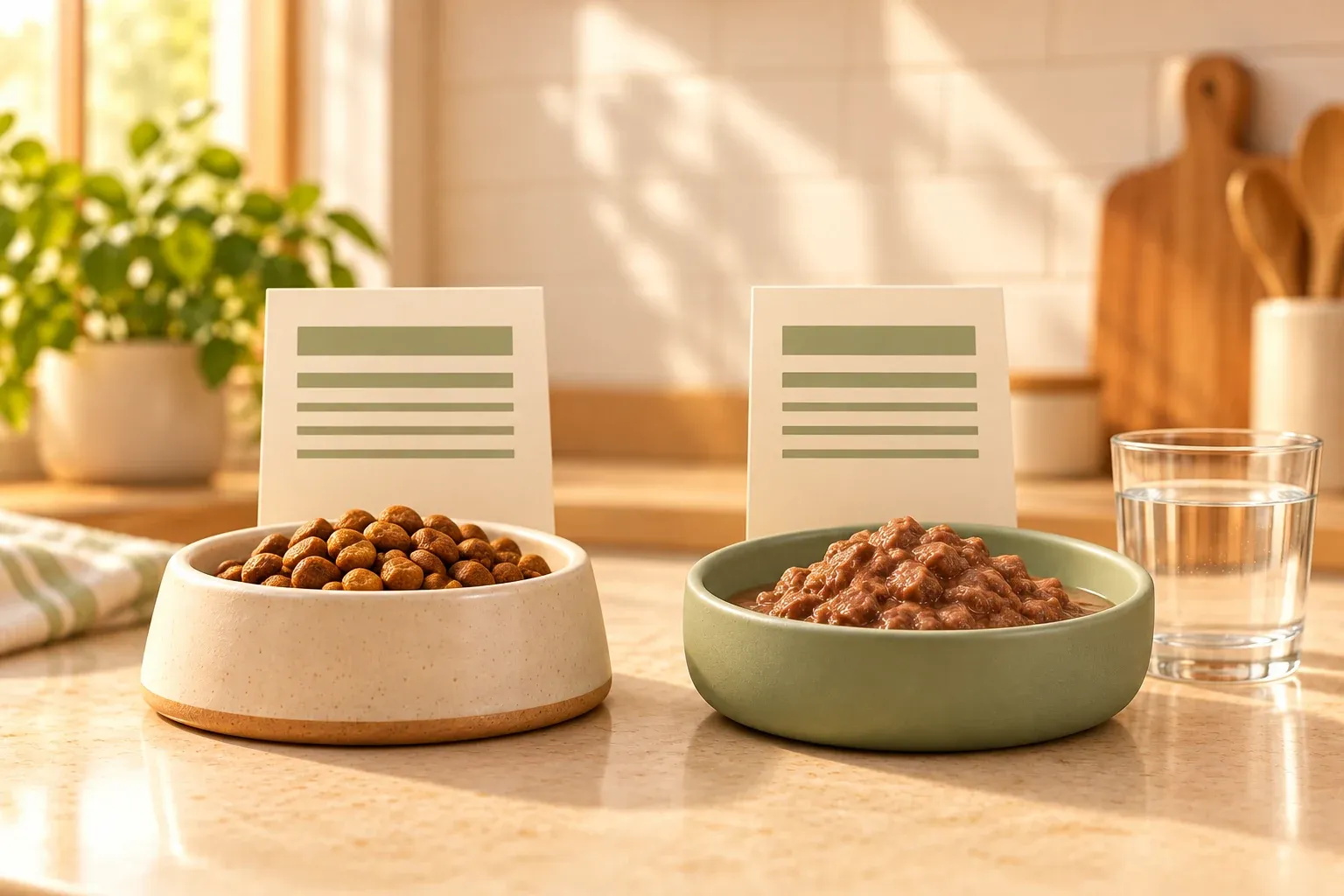
Ask the manufacturer for a typical analysis on the same basis for both products, or bring the labels to your veterinarian. The WSAVA guide specifically suggests asking for a typical analysis when information beyond the guaranteed analysis is needed. Avoid doing a comparison with one product’s minimum and another product’s average.
Record calories with their unit. A can, a pouch and a scoop are different quantities. Keep the package’s unit beside the number when you write it down, and have the clinic set the feeding plan if you need help with portions.
What should you save after choosing the food?
Keep photographs of the front, the information panel and the lot code. The front identifies the formula; the other pictures preserve details that disappear when the bag goes in the recycling.
Then record what your pet ate in a pet food diary. A label describes a product. The diary records the amount, treats and changes the clinic needs to understand the actual diet. Our pet health records guide shows how that fits beside visit notes and weight entries.
If someone else feeds your pets, share the exact product name and the current instructions. A pet sitter’s daily report can confirm what was offered and what was left. If a recall is announced, use the saved batch details to check the affected pet food; a matching brand name alone is not enough.
Where Dana fits
Dana’s Food Scanner lets you photograph food, treats or an ingredients panel and check it for the dog or cat you select. Review the ingredients it read before relying on its answer, especially if a photograph is blurred or incomplete. The scanner helps check ingredients; your veterinarian sets a prescribed diet and any changes to it.
Questions people ask
What should I check first on a pet food label?
Check which species and life stage the product is intended for, then find its nutritional adequacy statement. Those checks come before comparing ingredients or package claims. Ask your veterinarian about food for a pet with a medical condition.
Does the first ingredient prove a food is better?
No. The FDA says ingredients are listed by weight. That order alone does not establish the finished food's nutritional quality or whether it suits your pet.
Can I compare protein percentages on wet and dry food?
The percentages on the guaranteed analysis include each food's moisture. A direct comparison can mislead. Ask the manufacturer or your veterinarian for figures on the same basis.
Does a treat replace a complete diet?
A treat should not be assumed to provide complete nutrition. Read the product's intended use and adequacy statement rather than treating every bag in the pet food aisle as a full diet.