
Pet passport vs health certificate: it depends where you go
Britain, the EU and the US each want a different travel document. Which one your dog needs, who issues it, and how long each one stays valid.

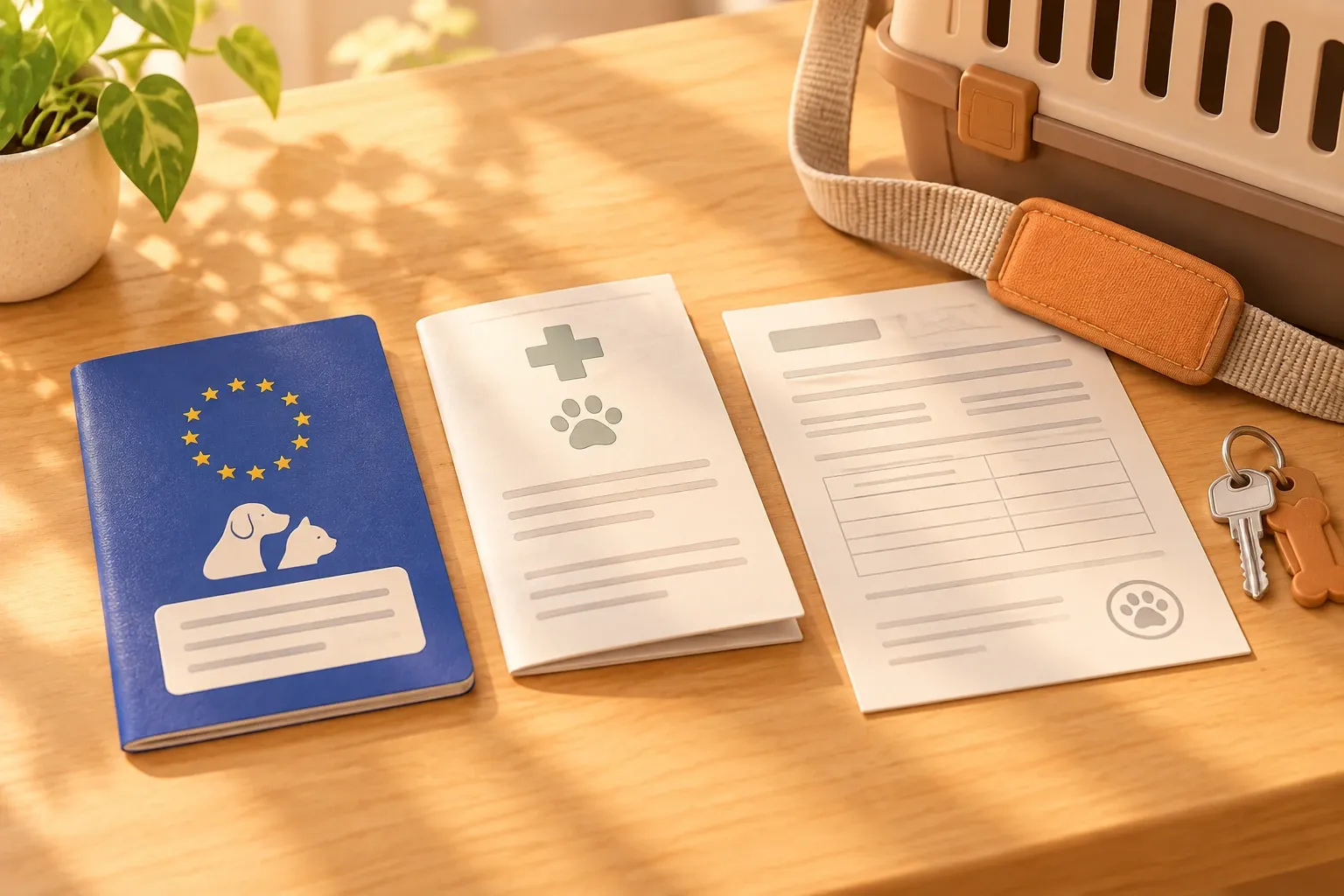
The airline page says a health certificate is required. A forum thread insists you need a pet passport. The template you found online has a slot for the dog’s photo and a place for a stamp, and it looks official enough to print.
Which document you need depends on where you are leaving from and where you are arriving: an EU pet passport, a Great Britain animal health certificate, a USDA-endorsed export certificate, or a CDC Dog Import Form receipt. Different authorities issue them, and each one expires on a different clock.
Is a pet passport the same as a health certificate?
No. A pet passport is a booklet that stays with the animal from trip to trip. An animal health certificate is a single-trip document whose life is measured in days. GOV.UK is blunt about confusing the two: “If you use a pet passport instead of an animal health certificate, your pet may be refused entry.”
Where you live decides which one is even available to you. GOV.UK states that residents of England, Scotland and Wales cannot use a pet passport to enter the EU, even if the passport was issued in the EU, while a resident of Northern Ireland still can.
Which document does your trip need?
Five journeys cover most of what a household does, and every row below comes from the authority that issues the document: GOV.UK for Great Britain, the European Commission for the EU, USDA APHIS and the CDC for the United States.
| Journey | Document | Who issues it | How long it lasts |
|---|---|---|---|
| Living in England, Scotland or Wales, going to the EU | Animal health certificate | Your vet, signed by an “official veterinarian” | 10 days to enter, then 6 months onward and for re-entry to Great Britain |
| Living in the EU or Northern Ireland, moving within the EU | EU pet passport | An official or authorised vet, to the model set in EU law | No trip limit; passports issued before 29 December 2014 are still accepted, and the rabies vaccination inside must stay in date |
| Leaving the US for another country | USDA-endorsed export health certificate, plus whatever the destination adds | A USDA-accredited vet issues it, USDA endorses it | Set by the destination country |
| Entering or returning to the US with a dog | CDC Dog Import Form receipt | You file it with the CDC before you travel | Six months of multiple entries from the same country of departure for a dog from a rabies-free or low-risk country; one entry only if the dog has been in a high-risk country |
| One US state or territory to another | Whatever the receiving state asks for, often a certificate of veterinary inspection | A veterinarian | Set by the destination state |
Two rows carry a date trap. GOV.UK’s animal health certificate page gives that certificate 10 days for entry into the EU, then 6 months for onward travel and for re-entry to Great Britain, and says your pet will need a new one each time you travel from Great Britain to the EU.
The US return leg has a cutoff of its own. The CDC states that “Any USDA export health certificates issued after July 31, 2025, are not accepted for meeting CDC dog importation requirements”. For a US-vaccinated dog coming home from a high-risk country, it names the Certification of U.S.-issued Rabies Vaccination form as the replacement, and that form has to be submitted to USDA and endorsed before the dog leaves the country. Where the dog has been also sets the receipt’s own clock: the CDC’s form instructions give a low-risk-country receipt six months of multiple entries from the same country, and a high-risk-country receipt a single entry.
Does the microchip have to come before the rabies vaccination?
Yes, and it is the one rule Britain and the United States state independently of each other. GOV.UK puts it as a consequence: “You must get your pet microchipped before, or at the same time as, their rabies vaccination. If you do not, they’ll need to be vaccinated again.” The CDC says the same thing from the other direction: “The rabies vaccination must also have been administered after the dog’s microchip was inserted.”
Get the order wrong and the vaccination stops counting for travel, so the document built on it cannot be issued. The sequence is settled months before the trip is booked. That is why each vaccine’s next due date belongs next to the certificate, and why a registry check before the vet appointment is worth the minute if you are unsure the chip is recorded in your name.
Can you download a pet passport template?
The EU pet passport is a model laid down in law, not a layout you can print. For pets travelling with their owners, the European Commission points at Regulation (EU) 2016/429, the Animal Health Law, and Commission Delegated Regulation (EU) 2026/131. The model itself sits in Commission Implementing Regulation (EU) 2026/705: 100 × 152 mm, a blue cover with the EU’s yellow stars, headings in a sequence that “shall be strictly respected”, and a rule that once Section III is filled in, “a transparent adhesive laminate shall seal the page”. Blank ones reach only official and authorised veterinarians, who “shall not distribute those blank passports further”.
A booklet you filled in yourself is a keepsake. Two things make a passport real: the model it matches, and the veterinarian who signed and dated it. The European Commission keeps the EU-side rules for moving dogs, cats and ferrets in one place.
Who decides for a flight inside the US?
The destination state does. USDA APHIS states it without qualification: “APHIS doesn’t regulate the interstate movement of pets by their owners. Domestic movement requirements are set by the receiving State or Territory.”
That is why search results contradict each other here. They are answering two different questions. APHIS carries a live selector for most states and territories, and tells you to contact the State animal health official for any that is not listed.
The USDA endorsement people ask about belongs to a different journey altogether. On its Travel With a Pet page, APHIS describes a USDA-accredited veterinarian helping you obtain “a USDA-endorsed pet health certificate or other needed paperwork” for a pet leaving the United States. If nobody at your clinic holds that accreditation, the CDC gives two routes: a veterinarian there can become accredited, or you can move the dog’s records to a clinic that already has one and start a record there.
Hawaii is the state where the paperwork has a price on it. The Hawaii Department of Agriculture and Biosecurity states that Hawaii is rabies-free, that Chapter 4-29 of the Hawaii Administrative Rules governs bringing dogs and cats in, and that dogs and cats which do not meet all of the 5 Day Or Less program requirements are quarantined for up to 120 days on arrival. Read in September 2026, its fee schedule charges $244 per animal for airport release “when documents are not received by the Animal Quarantine Station 10 days or more before arrival”, instead of $185.
Whose name is on the certificate, and who carries it?
One person’s, and EU law is specific about which. Under Delegated Regulation (EU) 2026/131, a pet passport must be signed by the pet owner and issued in the Member State where that owner habitually resides. The Great Britain certificate is signed by an official veterinarian, and GOV.UK says the vet hands the owner a separate declaration to sign, confirming the pet will not be sold or re-homed abroad.
In a household where care is shared, the person who books the vet is often the person who stays home. One certificate can carry up to 5 pets and its window to enter the EU is 10 days wide, so the appointment and the flight sit in two different calendars. The certificate travels with whoever reaches the counter, which in practice means a copy on more than one phone, along with the rabies certificate underneath it. If the trip is a one-way move, the order the paperwork has to happen in is in moving abroad with a dog. The airline sets its own rules on top of the documents, and for a pet in the cabin on Air Canada, the Air Canada pet cabin checklist covers the booking, the carrier and check-in.
Where Dana fits
Dana keeps a pet’s paperwork in health records, so a certificate lives with the animal and reaches whichever phone gets to the counter. Shared care gives every caregiver their own access, and Records Vault (Pro) shares a single record through a code-gated link that expires, which suits a document a sitter or a relative needs for exactly one trip. The wider system is in pet health records, organized for real life.
Questions people ask
Does my dog need a pet passport for a domestic flight?
A pet passport is a cross-border document, so it has no role inside one country. For a flight between US states, USDA APHIS says domestic movement requirements are set by the receiving state or territory.
Can one animal health certificate cover more than one pet?
Yes. GOV.UK states that you can add up to 5 pets to an animal health certificate, which matters when a household travels together and only one person books the appointment.
Do I need a new document for every trip?
It depends which document. GOV.UK says your pet needs a new animal health certificate each time you travel from Great Britain to the EU. The CDC Dog Import Form receipt works differently: for a dog coming from a rabies-free or low-risk country, one receipt covers multiple entries for six months as long as the country of departure does not change. A dog that has been in a high-risk country gets one entry per receipt.
My vet is not USDA-accredited. Does that matter?
For the paperwork a dog needs before it leaves the United States, yes: the Certification of U.S.-issued Rabies Vaccination form and USDA export health certificates both have to come from a USDA-accredited veterinarian. The CDC gives two routes. A veterinarian at your clinic can become accredited, or you can move the dog's records to a clinic that already has one and start a record there.